
MCB 413 Medical Virology Course Outline: First Semester 2026 at University of Uyo. Explore Lecture 1 on Viral Vaccines, and chemotherapy of viral diseases. A complete guide for UNIUYO undergraduate.
MCB 413 Medical Virology: First Semester
VACCINES AND CHEMOTHERAPY OF VIRAL DISEASES/INFECTIONS
LECTURE 1: VIRAL VACCINES
INTRODUCTION
Vaccine: The word “vaccine” originates from the Latin Variolae vaccinae (cowpox), which Edward Jenner demonstrated in 1798 could prevent smallpox in humans. Vaccines are administered in liquid form, either by injection, by oral, or by intranasal routes. A vaccine can also be defined as any preparation intending to produce immunity to a disease by stimulating the production of antibodies.
Vaccination: Is the administrations of antigenic materials (vaccines) to produce immunity to a disease.
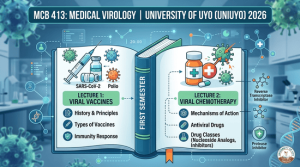
Viral vaccines are suspensions produced by viruses or their components that induce protective immunity or stimulate the body immune response to viral infections. Several vaccines have proved to be remarkably effective at reducing the annual incidence of viral disease.
Read Also: JIGPOLY School Fees 2026/2027: Complete Fee Breakdown & Registration Guide for HND, ND, NCE Students
HISTORY OF VACCINATION
The first attempts to prevent disease by using the disease-causing organism against itself are reported from 7th Century India where Buddhist Monks drank snake venom in order to develop immunity against snake bite.
Variolation, the process of inoculating the dried pustules of smallpox (caused by the Variolae virus) from a sick individual into a healthy individual, to prevent the healthy individual from developing the disease, was developed in Central Asia in the second millennium. The practice then spread east to China and west to Turkey, Africa and Europe.
In 1798, in England, Edward Jenner published the results of his experiments on “vaccination”, the process of inoculating the cowpox virus (closely related to the human smallpox virus), Variolae vaccinae, to prevent smallpox in humans. The term vaccination was derived from vaccinae virus. The practice became widely popularized.
At the end of the 19th century, Louis Pasteur began to apply the concept of vaccination to other diseases. He demonstrated that the harmful nature of disease-causing organisms could be weakened or attenuated in the laboratory.
He first demonstrated the effectiveness of vaccines against, chicken, cholera and anthrax in animals, before developing his vaccines against rabies for use in humans in 1886.
In 1886, in the US, Daniel Elmer Salmon and Theobald Smith demonstrated that vaccines could be produced not just from living organisms but also from killed disease-causing organisms. Their discovery led to subsequent development of inactivated vaccines against several human diseases.
In the early 20th century, it was discovered that some diseases were caused not by bacteria themselves but by the toxins that they produced. Inactivated toxins acted like vaccines by providing protection against these toxin-induced diseases. These vaccines are known as toxoids.
By the end of the 20th century, a spurt of innovation led to the development of several new methods of producing vaccines including by recombinant organisms, by conjugation of polysaccharides to carrier proteins, and by the assembly of virus-like particles.
BASIC PRINCIPLE OF VIRAL VACCINES
The basic principle of administering viral vaccines (vaccination) is to present antigens to the immune system in such a way as to stimulate immunity against the fully virulent organism without causing disease. The vaccine antigens (whole attenuated or inactivated virus or protein subunits of virus) are processed in a way similar to that of the wild-type virus.
When the vaccine is injected, the virus or viral proteins are taken up by macrophages, processed, and presented to helper T lymphocytes, which then orchestrate the immune response. The immune system is thus primed so that encounter with wild-type virus results in its elimination.
TYPES OF VIRAL VACCINES
1. Inactivated (or killed) vaccines: These vaccines are produced from whole organism that have been inactivated by chemical (formaldehyde) or physical (thermal or heat) agents or other means. They do not provide long lasting immunity and so require booster doses. Examples are, Polio (salk) [IPV] vaccine, Hepatitis A vaccine, Influenza vaccine, Rabies vaccine, etc.
2. Live attenuated (or weakened) vaccines: Here, the virus is ‘attenuated’ by serial passage in cells or host tissues or by cultivation under sub-optimal conditions (also called attenuation) or from genetic modification. Provides long lasting immunity, and one dose usually suffices.
Examples of live attenuated virus vaccines are: polio (Sabin) vaccine, measles, mumps and rubella (MMR) vaccines, rabies vaccine, varicella (chicken pox) vaccine, vaccinia (small pox) vaccine, yellow fever vaccine, zoster (shingles) vaccine, rotavirus vaccine and influenza vaccine.
3. Recombinant/Subunit vaccines: Recombinant/Subunit vaccines are made by purifying an immunogenic viral protein, polysaccharides or nucleic acids; and incorporating it into a vaccine.
Examples are: hepatitis B vaccine, produced from hepatitis B surface antigen (HbsAg) that was purified from the blood of hepatitis B carriers and human papilloma virus (HPV) vaccine.
4. Vector vaccine: Vector vaccines consist of a relatively nonpathogenic virus incorporating a gene, from a virulent virus, which encodes antigenic protein.
The strategy is that during the mild infection by the vector virus, protein from the DNA of the virulent virus is also presented to the immune system without actual infection by the virulent virus. The advantage of a vector vaccine is that the DNA of several different virulent viruses can be incorporated so that immunity is induced to more than one virulent virus.
There were initially no vector vaccines available for human use. Currently, it has been reported that the University of Oxford/AstraZeneca vaccine uses this technology to protect against COVID-19.
This type of vaccine uses an unrelated harmless virus (the viral vector) to deliver SAR-CoV-2 genetic material. When administered, our cells use the genetic material to produce a specific viral protein which is recognized by our immune system and triggers a response and can also build immune memory against future infection.
5. Genetic Vaccine: Genetic vaccines are a variation on the vector vaccine theme. Here, a segment of viral DNA or RNA coding for an immunogenic peptide is injected directly into muscle, and synthesis of the peptide occurs in the host cell.
The peptide is expressed on the surface of the cell in conjunction with a type 1 major histocompatibility complex molecule and is recognized by the immune system, which is then activated and primed.
DNA vaccines are still under development and none is available for human use. The most current genetic vaccines are the Moderna and Pfizer/BioNtech COVID-19 vaccines.
The vaccines contain a segment of the genetic material of the SARS-CoV-2 virus, which causes COVID-19. The genetic material for Moderna is RNA, while PfizerBioNtech vaccine codes for a specific viral protein.
LECTURE 2: VIRAL CHEMOTHERAPY
INTRODUCTION
Viral chemotherapy is the clinical application of antiviral drugs or medications to treat viral infections. Antivirals can be used to treat established infections when vaccines are not available or not highly effective.
Antivirals are needed to reduce morbidity and economic loss caused by viral infections and to treat increasing numbers of immunosuppressed patients who are at increased risk of infection.
Antivirals, unlike antibacterial or anti-protozoan drugs have a number of limitations, since viruses rely on host cell machinery for replication. Because viruses are obligate intracellular parasites, antiviral agents must be capable of selectively inhibiting viral functions without damaging the host, making the development of such drugs very difficult. Another limitation is that many rounds of virus replication occur during the incubation period and the virus has spread before symptoms appear, making a drug relatively ineffective.
BASIC MECHANISMS OF ANTIVIRAL DRUGS
The mechanisms of action of antiviral drugs differ greatly. Often the drug must be activated by enzymes in the cell before it can act as an inhibitor of viral replication; the most selective drugs are activated by a virus encoded enzyme in the infected cell. Several events in the virus replicative cycle either do not occur in normal uninfected cells or are controlled by virus-specified enzymes that differ structurally and functionally from the corresponding host cell enzymes. This understanding has been exploited in the production of antiviral drugs.
Schematically, the virus replicative cycle can be divided into 10 steps: (1) adsorption, (2) penetration, (3) uncoating, (4) early transcription, (5) early translation, (6) replication of the viral genome, (7) late transcription, (8) late translation, (9) assembly, and (10) release of new virus particles.
Adsorption, penetration, and uncoating are typical examples of replicative events that are specific for virus infection and do not occur in uninfected cells.
Examples of virus replication steps controlled by virus-specified enzymes are the transcription of positive-sense RNA to DNA (catalyzed by the reverse transcriptase associated with retroviruses), the replication of DNA to DNA (catalyzed by the DNA polymerases of herpesviruses), and the proteolytic cleavage of viral precursor proteins (catalyzed by the protease of human immunodeficiency virus).
The various steps in the replicative cycle at which the virus deviates from normal host processes are potential targets for chemotherapeutic intervention. It is not yet possible to tailor new antiviral agents to virus-specific target molecules.
The molecular modes and targets of action for some of the approved antiviral drugs remain to be better defined. Based on their mode or mechanism of action, the different types of antiviral chemotherapies are:
1.) Nucleoside Analogs
The majority of available antiviral agents are nucleoside analogs. They inhibit nucleic acid replication by inhibition of polymerases essential for nucleic acid replication.
In addition, some analogs can be incorporated into the nucleic acid and block further synthesis or alter its function. Analogs can also inhibit cellular enzymes and virus-encoded enzymes. Examples of nucleoside analogs include acyclovir (acycloguanosine), lamivudine (3TC), ribavirin, vidarabine (adenine arabinoside), and zidovudine (azidothymidine; AZT).
2.) Nucleotide analogs:
They differ from nucleoside analogs in having an attached phosphate group and act by inhibiting DNA polymerase thereby disrupting nucleic acid replication. Their ability to persist in cells for long periods of time increases their potency. Cidofovir is an example.
3.) Reverse Transcriptase Inhibitors
They act by binding directly to reverse transcriptase and disrupting the enzyme’s catalytic site. An example is Nevirapine, the first member of the class of non-nucleoside reverse transcriptase inhibitors. Resistant mutants emerge rapidly.
4.) Protease Inhibitors
Saquinavir was the first protease inhibitor to be approved for treatment of HIV infection. It is a peptidomimetic agent designed by computer modeling as a molecule that fits into the active site of the HIV protease enzyme.
Such drugs inhibit the viral protease that is required at the late stage of the replicative cycle. Inhibition of the protease yields noninfectious virus particles. Protease inhibitors include indinavir and ritonavir and other newer ones.
Course by: DR. UBONG E. ETANG
Hope this article has been helpful? Kindly share for others to benefit.
Disclaimer
The information in this post is a study guide only for MCB 413 Medical Virology at the University of Uyo (2026), based on lectures by Dr. Ubong E. Etang. It is provided for educational and informational purposes only and does not constitute medical advice, diagnosis, or treatment. It is not an official University publication. While we strive for academic accuracy, students are strongly advised to cross-reference this material with their latest official university notes, textbooks, and primary lecturers. The blog author and publisher assume no liability for errors, omissions, or any academic or other consequences arising from the use of this information.

On this platform, Anny shares reliable updates on career counselling, scholarships, and education editorials to help students and job seekers make informed decisions about their future. Her goal is simple: make career and education information clear, accessible, and trustworthy.
- Boosting Nile Tilapia Health: The Power of Ixora coccinea & Organic Acids on Blood and Biochemical Responses - May 28, 2026
- Yoruba Language Past Questions for SS3: Revision Mock Paper I & II - May 27, 2026
- Complete List of President Tinubu’s 48 Ministers & Portfolios (Updated 2026) | Nigeria Current Affairs - May 26, 2026