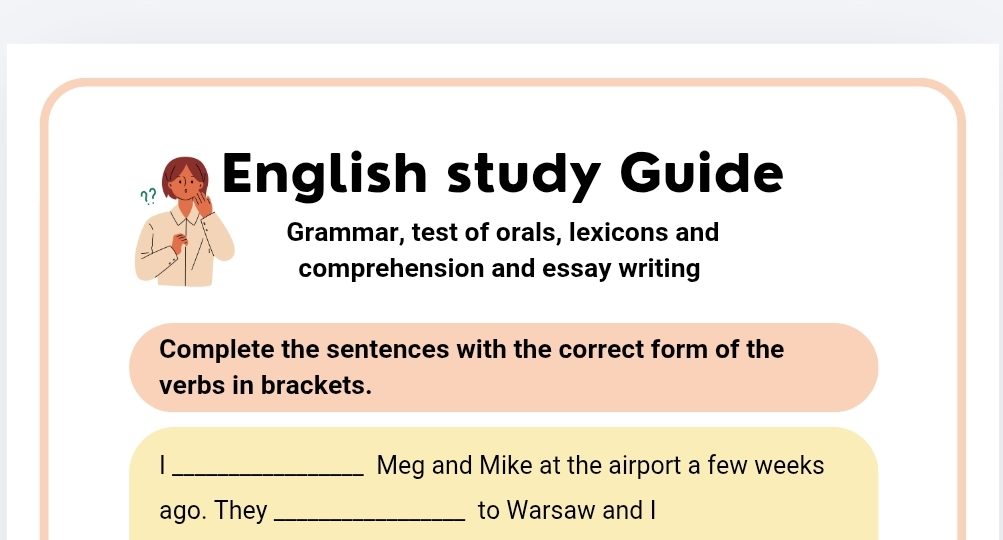
Complete SS2 English Language Third Term Study Guide PDF for Nigerian students covering grammar, Literature, and comprehension. Resources are completely free for students, teachers and professional.
Complete SS2 English Language Third Term Study Guide PDF
THIRD TERM EXAMININATION 2023/2024 SESSION
CLASS: GRADE 11 SUBJECT: ENGLISH 2 TIME : 2HR
SECTION 1: ESSAY
Answer ONE question only from this section. All questions carry equal marks. Your answer should be NOT be less than 450 words.
- Write a letter to your friend who is in another school telling him or her the valuable lessons you have learnt during a recent excursion.
- Several articles have been published on the alarming rate of indiscipline among the youth of your country. Write your contribution.
- Cases of malaria have been on the increase in recent times in your country. Write a letter to the Minister of Health, discussing your observation and suggesting at least three ways of curbing the disease.
- You have just been awarded a scholarship by a local company. Write a speech you would deliver at the presentation ceremony stating the benefits of the scholarship.
- Write a story that ends with the statement: And Dad was right after al
SECTION 2- VOCABULARY
In the following passage, the numbered gaps indicate missing words. Against each number in the list below each passage, four options are offered in columns lettered A to D. Choose the word that is the most suitable to fill the numbered gaps in the passage.
An entrepreneur is a person who organises and manages any business enterprise, or one who combines the other factors of —71— to start a business and make a profit. He possesses considerable initiative and is willing to take —72—. An entrepreneur can be a farmer, a dressmaker, a factory owner, a wholesaler or a — 73—. More often than not, it is best for an entrepreneur to start a business from scratch rather than —74— in or buy an existing business. One advantage is that he would be independent and not become a —75— or get to inherit some bad debt. The —76— of a good entrepreneur must include hard work, innovation and creativity. He must be well informed and confident to make worthwhile decisions. As it takes a great deal of energy, time and money to operate one’s own business, entrepreneurs must seek to possess good managerial —77— in order to manage their business successfully. But how useful is the entrepreneur to the society? He is an innovator who develops new —78— and services to make life easier and more comfortable. He plans, organises, directs and —79— his business activities effectively thus minimising wastage of limited —80— and enhancing
A B C D
- Production provision construction creation
- debts risk pitfalls problems
- retailer peddler hawker trader
- plunge break invest delve
- colleague partner fellow comrade
- tendencies properties features attributes
- knack talent skills foresight
- products yield out materials
- bridles check restrain control
- assets resources stock wealth
SECTION 3- COMPREHENSION
Read the following passage carefully and answer the questions on it.
Kola’s parents were quite loving and kind. They wanted to bring up their only son well. They worked hard to make ends meet but provided him and his siblings with all their materials needs. Also, they taught him to respect elders by never questioning their authority or looking into their eyes when they spoke. It was the height of disrespect to say an elder was wrong or stand head raised when being addressed by him. Heads must be bowed and nodded in respectful affirmation of the wisdom emanating from the lips of the elderly. A young person was not expected to be as knowledgeable as an elder. According to an adage, what an elder sees lying down, the young cannot see from the top of a tree. An infringement of these rules attracted instant reprimands.
Many people grew up in this atmosphere a few decades ago. The few recalcitrant ones who always broke the rules paid dearly for it and were labelled rude and incorrigible. Kola wanted to be termed good and well-behaved. He did all that was expected of him and enjoyed additional affection from his parents and elders. But he paid a price for it – fear. He was always afraid to express views that could be contrary to those of elders no matter how strongly he felt about them. The fear grew and spread even to his relationship with his mates. He was afraid of being pronounced rude or wrong.
Gradually, he lost his self- confidence. This affected his speech as he started to stutter and stammer. The condemnation by his parents and elders, combined with the ridicule of his mates, worsened the matter. At the end of his secondary school career, Kola realized that his strength was academics. He was among the best five in his class. He gained admission to a renowned university and applied himself to his studies. Apart from his textbook, he read novels and biographies and listened to discussions on tropical issues on radio and television. His lecturer soon recognized his academic prowess and encouraged him. His mates admired and sought after him especially when given difficult assignments in the courses they had in common. His speech improved, and by the time he graduated with a second class upper in English Language, he had become a powerful speaker who could also use eye-contact and body language to sway his audience.
- In what two ways were young people expected to show respect when an elder spoke?
- How does the writer show that rules mentioned in the passage are no longer imposed?
- What two factors gave rise to Kola’s speech problems?
- State two things that helped Kola to regain his confidence.
- Contrast the at Kola’s mates in secondary school with that of his university
- “…… to make ends meet …….
“What does this expression means?
- “…… to be termed good and well behaved.”
- i) What grammatical name is given to this expression as it is used in the passage?
- ii) What is its function?
h). For each of the following words or phrase, find another word or phrase which means the same and which can replace it as it is used in passage:
- i) the height of;
- ii) infringement;
iii)recalcitrant;
- iv)renowned
- v) prowess;
- vi) sway.
Read Also: The Ultimate Unilorin Student Guide: How to Pass CBT Exams and Calculate Your CGPA (2026)
SECTION 4- SUMMARY WRITING
Read the following passage carefully and answer the question on it.
Nowadays, technology has taken over virtually every area of our lives. One remarkable manifestation of this “colonization” is the social media such as Twitter, Facebook and Instagram. Social media platforms can only be accessed via computers and handheld devices such as phones and tablets that are connected to the Internet. These devices can be purchased at affordable prices. With the advent of modern-day communication outlets, conventional media such as the radio, television and newspaper are increasingly trailing behind social media in terms of information dissemination. Indeed, not only have social media platforms expanded the communication space, they have also made it difficult for regulators to censor the news. Most people obviously welcome and indeed celebrate, this apparent freedom.
In expressing their satisfaction in this regard, social media enthusiasts often argue that the tools have revolutionized the socialization process. For instance, people have been known to make new friends and reunite with old ones just after opening social media accounts. Certainly, there is a lot to be said about this capacity of social media tools to connect and reconnect people. It has also been suggested that social media tools have radically transformed the way we conduct business. For instance, the tools can be easily used to advertise products and services at little or no cost. The tools have therefore made it unnecessary for business people to set up office spaces where customers and clients can meet them. Another dimension to this is that products tend to be much cheaper since the cost of office space would have been eliminated.
Social media tools have also been used to provide humanitarian and emotional support to people in need, whether as individuals or as a group. For example, appeals for support have been successfully made for ailing public figures and some ordinary members of the public. In fact, in some of the cases the money realized ran into millions.
Similarly, people contemplating suicide who dared to voice their frustration and intention online have been known to have received calls and messages which helped to change their minds. Nothing could be more soothing than when they know that thousands of people out there, some of them totally strangers, actually care about them and want them to stay alive and realize their potentials. It is even more soothing when those who lend them support confess that they have walked that path before. No doubt, they are more persuaded by words of advice from such people.
However, it is also clear that social media tools have done considerable harm to social relations. It is not uncommon to hear or read of cases where unflattering pictures of people have been maliciously released to the public via social media platforms. Social media tools have also been used to scam unsuspecting contacts on a person’s social media account. In addition, they have been used to peddle sheer falsehood about others, among other negative practices. Whichever purpose for which anybody may use social media tools, it is clear that they have become an indispensable part of contemporary life.
QUESTION
- In three sentences, one for each, state the arguments in favour of social media
- In three sentences, one for each, state the effects, of social media on business activities.